
How Montessori Language Activities Prepare Children for Reading and Writing
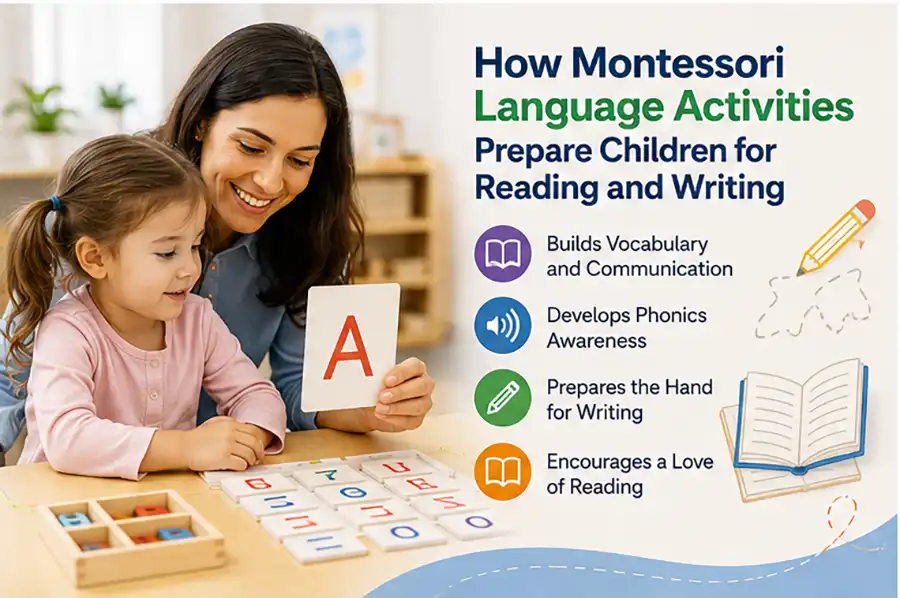
Language development is one of the most important parts of early childhood education. Before children learn to read and write independently, they need to build vocabulary, listening skills, sound awareness, confidence, and a love of communication. Montessori language activities prepare children for reading and writing.
In a Montessori environment, language learning happens naturally throughout the day. Children are introduced to sounds, stories, songs, vocabulary, conversation, pre-writing activities, and early reading materials in a hands-on and developmentally appropriate way.
BrainBox Montessori describes its language curriculum as introducing children to speaking, writing, and reading through a vocabulary-rich environment, sound games, stories, poems, sandpaper letters, and the moveable alphabet.
Language Begins with Listening and Speaking
Before children read words, they need to hear and understand language. Montessori classrooms encourage conversation, storytelling, songs, rhymes, and group discussions. These activities help children develop listening skills and expand their vocabulary.
A strong language environment gives children many opportunities to hear new words, ask questions, describe experiences, and express their ideas.
Building Vocabulary Through Everyday Experiences
Young children learn words best when they are connected to real experiences. In a Montessori classroom, vocabulary can be introduced through practical life activities, sensorial materials, nature, art, music, culture, food, classroom routines, and social interaction.
When children touch, move, see, and experience something, language becomes more meaningful. They are not only memorizing words; they are connecting words to the world around them.
Learning Sounds Before Reading
Sound awareness is an important step toward reading. Montessori language activities often introduce children to the sounds that make up words. Children may play sound games, identify beginning sounds, or match sounds with letters.
This prepares children for phonics in a gentle and engaging way. Instead of rushing into reading, Montessori education helps children build the foundation step by step.
Preparing the Hand for Writing
Writing is not only a language skill. It is also a physical skill. Children need hand strength, coordination, and control before they can write comfortably.
Montessori practical life and sensorial activities help prepare the hand for writing. Pouring, sorting, tracing, carrying, arranging, and using classroom materials all strengthen fine motor skills. Sandpaper letters also allow children to trace letter shapes and connect movement with sound.
The Moveable Alphabet
The moveable alphabet is a classic Montessori material that allows children to build words before they are ready to write them by hand. Children can arrange letters, explore sounds, and form words in a hands-on way.
This helps children understand that words are made of sounds and letters. It also gives them confidence because they can begin creating words without the pressure of perfect handwriting.
Encouraging a Love of Books
Reading should feel enjoyable, not stressful. Story time, poems, songs, and picture books help children associate language with warmth, imagination, and discovery.
When children are surrounded by books and meaningful conversation, they are more likely to develop a positive attitude toward reading.
Why Montessori Language Learning Works
Montessori language activities support the whole child. They combine listening, speaking, movement, touch, sound, visual recognition, and creativity. This makes language learning more natural and engaging for young children.
At BrainBox Montessori in Langley, language development is part of a broader curriculum that supports children’s academic, social, emotional, and creative growth. For parents looking for a strong early learning foundation, Montessori language activities can help children become confident communicators, early readers, and enthusiastic learners.