
Why Sensorial Learning in Montessori Is Important Education
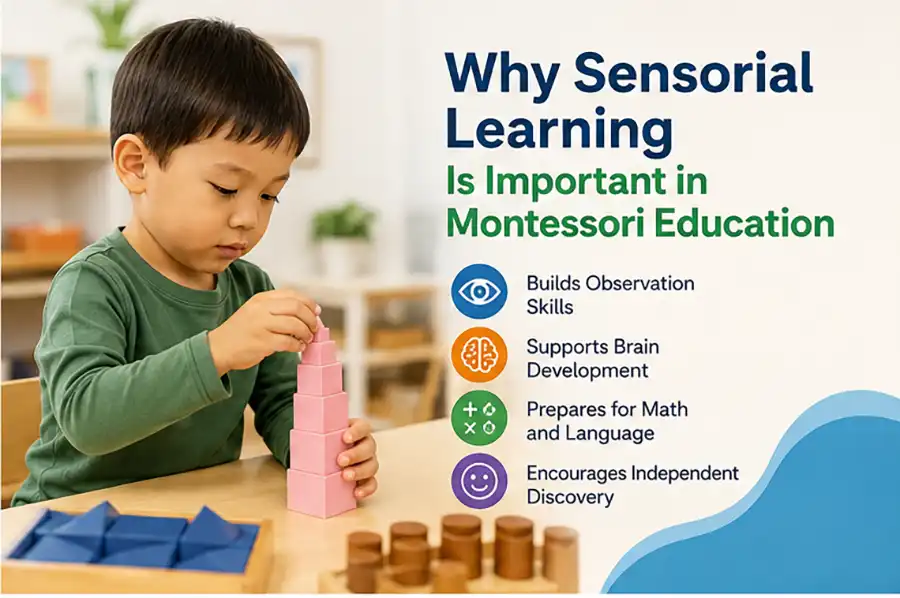
Young children learn through their senses. They touch, see, hear, smell, compare, sort, and explore the world around them. In Montessori education, this natural way of learning is supported through sensorial activities.
For parents looking for a Montessori daycare in Langley, understanding sensorial learning can help explain why Montessori classrooms are carefully prepared with hands-on materials. These materials are not just toys. They are designed to help children develop observation, concentration, order, and problem-solving skills.
What Is Sensorial Learning in Montessori?
Sensorial learning focuses on helping children understand the world through their senses. Children may work with materials that allow them to compare size, shape, colour, texture, sound, weight, length, and dimension.
Through these activities, children learn to notice differences and similarities. They begin to classify information and organize their thinking. This is an important foundation for later learning in math, language, science, and everyday problem-solving.
BrainBox Montessori’s curriculum includes sensorial learning as part of its Montessori program, along with practical life, language, math, science, art, music, movement, and culture.
Helping Children Develop Observation Skills
Observation is one of the most important early learning skills. A child who can notice detail is better prepared to understand patterns, letters, numbers, shapes, and relationships.
Sensorial materials encourage children to slow down and pay attention. For example, they may compare objects by size, match colours, arrange materials from smallest to largest, or identify differences in sound. These activities help children sharpen their perception and become more aware of their environment.
Preparing Children for Math
Sensorial learning also supports early math development. Before children understand numbers on paper, they need to understand concepts such as size, quantity, order, comparison, sequence, and pattern.
Montessori materials often allow children to experience these ideas physically. A child can see, touch, and compare differences before moving into abstract math concepts. This makes learning more natural and meaningful.
Supporting Language Development
Sensorial learning also helps children build vocabulary. When children compare objects, teachers can introduce words such as long, short, wide, narrow, rough, smooth, heavy, light, bright, dark, loud, soft, same, and different.
These words help children describe what they see and feel. As their vocabulary grows, so does their ability to communicate clearly.
Encouraging Independent Discovery
One of the strengths of Montessori education is that children are encouraged to discover through hands-on work. Sensorial activities allow children to learn by doing, rather than simply listening.
This helps children become active learners. They are not just receiving information; they are exploring, testing, comparing, and understanding.
Building Confidence Through Repetition
Children often enjoy repeating sensorial activities. Repetition helps them master skills, correct mistakes, and build confidence. In a Montessori classroom, repetition is respected because it is part of how children learn deeply.
When children complete a task successfully, they feel proud. This sense of accomplishment encourages them to try new challenges.
Why Sensorial Learning Matters at BrainBox Montessori
At BrainBox Montessori in Langley, sensorial learning is part of a broader Montessori curriculum designed to support the whole child. Children are encouraged to explore materials, develop concentration, build vocabulary, and prepare for future academic learning in a natural and age-appropriate way.
For parents, sensorial learning is a reminder that early education is not only about worksheets or memorization. It is about helping children understand the world through meaningful, hands-on experiences.