
Montessori Daycare in Langley: How Hands-On Learning Supports Early Development
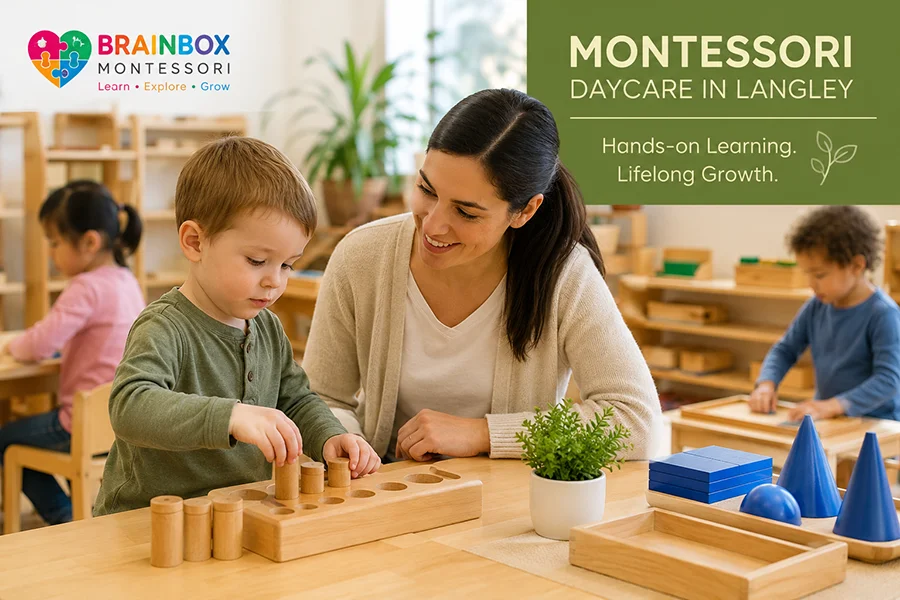
Young children learn by doing.
They touch objects, move materials, repeat activities, observe other people, test ideas, and gradually discover how the world around them works.
This natural way of learning is one reason many families are interested in Montessori daycare in Langley.
Montessori education emphasizes hands-on experiences, independence, concentration, and respect for each child’s individual development.
Instead of focusing primarily on lectures or worksheets, Montessori environments encourage children to actively participate in their own learning.
What Is Hands-On Learning?
Hands-on learning means children interact directly with materials rather than simply receiving information from an adult.
For example, a young child may learn about size by arranging objects from smallest to largest. They may explore numbers by physically counting objects or improve hand coordination by transferring items between containers.
These experiences combine thinking and movement.
For young children, this connection is especially valuable because they often understand concepts more easily when they can see, touch, and manipulate real objects.
Montessori Materials Have a Purpose
A Montessori classroom typically contains carefully selected learning materials.
Each activity is designed to help children practice a particular skill or concept.
Materials may support areas such as:
- Practical life
- Sensorial development
- Language
- Mathematics
- Fine motor coordination
- Cultural exploration
Many activities also include a built-in way for children to recognize mistakes and try again.
This allows children to become less dependent on constant adult correction.
Over time, they learn to evaluate their own work and develop greater confidence.
Practical Life Activities Build Independence
One important area of Montessori education is Practical Life.
These activities are based on tasks children see adults performing every day.
Examples may include:
- Pouring
- Sorting
- Spooning
- Cleaning
- Carrying objects
- Organizing materials
- Dressing skills
- Food preparation
These activities may appear simple, but they support several areas of development simultaneously.
A pouring activity, for example, can strengthen hand control, concentration, coordination, patience, and independence.
Children also enjoy participating in meaningful activities because they feel capable and involved.
Children Learn at Their Own Pace
Children develop at different rates.
One child may become interested in letters early, while another may spend more time strengthening practical or sensory skills.
A key characteristic of Montessori education is allowing children to progress according to their individual readiness.
Educators observe children’s interests and development, then introduce appropriate activities.
This approach can reduce unnecessary pressure while still providing structure and guidance.
For families researching Montessori daycare in Langley, this individualized approach is often one of the most attractive aspects of Montessori education.
Repetition Develops Concentration
Adults sometimes become surprised when children repeat the same activity again and again.
However, repetition is an important part of early childhood learning.
Each repetition allows children to refine a movement, strengthen a skill, and build greater understanding.
Montessori classrooms often provide uninterrupted periods during which children can select activities and work with them for meaningful periods of time.
This gives children opportunities to develop concentration.
The ability to focus on a task is an important skill that can support future learning in school and everyday life.
Freedom Within Clear Boundaries
Montessori classrooms offer children choices, but this does not mean there are no expectations.
Children may choose among appropriate activities while also learning classroom responsibilities.
For example, they may be expected to:
- Use materials carefully
- Return activities to their proper place
- Respect other children’s work
- Walk calmly indoors
- Wait when another child is using a material
This combination of freedom and responsibility helps children develop self-discipline.
Instead of relying entirely on adults to control behaviour, children gradually learn how their actions affect the classroom community.
Social Development in a Montessori Environment
Independence does not mean isolation.
Children still interact with classmates throughout the day.
They observe one another, work beside each other, participate in group activities, and practice communication.
Educators can help children learn respectful ways to express needs, solve disagreements, and participate in the classroom community.
These everyday interactions support social and emotional development.
Preparing Children for Future Learning
The purpose of Montessori education is not simply to teach children academic information earlier.
The broader goal is to help develop qualities that support lifelong learning.
These may include:
- Curiosity
- Confidence
- Independence
- Responsibility
- Concentration
- Problem solving
- Respect for others
When these foundations are established during early childhood, children may approach future learning with greater confidence.
Choosing Montessori Daycare in Langley
Parents considering a Montessori program should visit the classroom whenever possible.
Observe how the room is organized and how educators interact with children.
Look for an environment where materials are accessible, children are actively engaged, and educators provide guidance while still encouraging independence.
At Brainbox Montessori, the goal is to create meaningful learning experiences that allow children to explore, practice skills, and develop at their own pace.
Families looking for Montessori daycare in Langley can learn more by visiting the centre and discussing their child’s individual needs.
Frequently Asked Questions
What is different about Montessori daycare?
Montessori programs emphasize hands-on materials, independence, practical skills, concentration, and child-directed learning within a structured environment.
Does Montessori include academic learning?
Yes. Montessori environments can introduce language, mathematics, sensory concepts, and cultural topics through developmentally appropriate materials.
Is Montessori suitable for different learning styles?
The Montessori approach provides varied hands-on activities and allows children to progress according to individual readiness and interests.