
Daycare in Langley: Montessori vs. Traditional Daycare — 7 Differences Every Parent Should Know
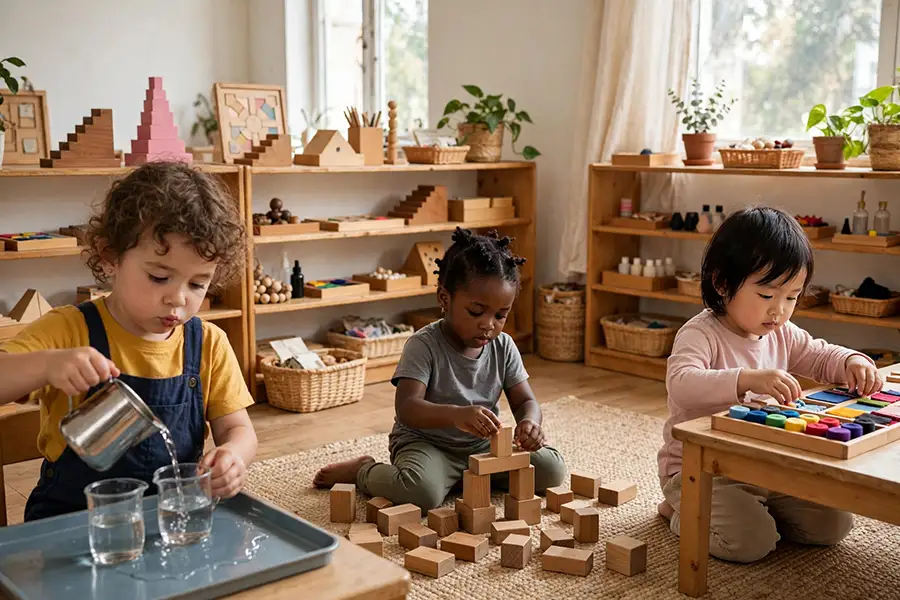
If you’re searching for daycare in Langley, you’ve probably noticed that not all programs look — or feel — the same. Some centres buzz with teacher-led circle time and craft projects. Others are calm, quiet rooms where toddlers pour water, polish wood, and choose their own work. Both call themselves daycare. But the experience your child has in each couldn’t be more different.
The biggest fork in the road for most families is Montessori versus traditional daycare. It’s one of the most common questions parents ask when touring daycare in Langley, and the honest answer is: neither is universally “better.” They simply work from different ideas about how young children learn best.
This guide breaks down 7 real differences between the two approaches — no jargon, no sales pitch — so you can decide which environment fits your child and your family.
Table of Contents
- What Is Montessori Daycare?
- What Is Traditional Daycare?
- 7 Key Differences Between Montessori and Traditional Daycare
- Which One Is Right for Your Child?
- Why Families Across Langley and Surrey Choose Brainbox Montessori
- Frequently Asked Questions
- Final Thoughts
What Is Montessori Daycare?
Montessori education was developed over a century ago by Dr. Maria Montessori, an Italian physician who observed that children learn best when they follow their own curiosity in a carefully prepared environment. A Montessori daycare in Langley applies those same principles to the youngest learners — typically infants through kindergarten age.
In a Montessori classroom, you’ll see child-sized furniture, hands-on learning materials arranged on low open shelves, and children of different ages working side by side. Teachers — called “guides” — are trained to observe each child closely and introduce new activities at exactly the right developmental moment, rather than teaching the whole group the same lesson at the same time. You can explore how this looks day to day in our Montessori curriculum.
The Association Montessori Internationale sets the global standard for authentic Montessori practice, including teacher training and classroom design.
What Is Traditional Daycare?
Traditional daycare is what most of us picture when we hear the word “daycare”: a warm, lively centre where a teacher leads the group through a planned daily schedule. Children are usually grouped strictly by age — all the two-year-olds together, all the three-year-olds together — and the day moves through familiar blocks: circle time, snack, craft activity, outdoor play, lunch, nap, and free play.
Traditional programs are often play-based, theme-based (think “ocean week” or “farm week”), or lightly academic, depending on the centre. The teacher decides what the group does and when, and children learn by participating together. For many families, this structure feels familiar and reassuring — and plenty of children thrive in it.
7 Key Differences Between Montessori and Traditional Daycare
Now the side-by-side comparison. As you read, picture your own child — their personality, energy level, and how they play at home. That picture matters more than any philosophy on paper.
1. Learning Philosophy: Child-Led vs. Teacher-Led
This is the fundamental divide. Montessori is child-led: the child chooses what to work on from a range of purposeful activities, and learning follows the child’s natural interests and developmental readiness. If your daughter is fascinated by pouring water, she might spend twenty focused minutes on it — and that’s considered real learning.
Traditional daycare is teacher-led: the educator plans the activities, and the group follows along together. Everyone paints at painting time; everyone sings at circle time. This builds wonderful group skills — listening, turn-taking, following instructions — but it leaves less room for individual curiosity to set the agenda.
Neither approach is wrong. But if your child is intensely independent or deeply focused, the difference will show up fast when you tour daycare in Langley options. You’ll see each philosophy in action within minutes of stepping into a daycare in Langley classroom — just watch who is making the choices.
2. Classroom Structure: Mixed-Age Groups vs. Same-Age Classes
Walk into a Montessori classroom and you’ll find a three-year age span — for example, children aged 3 to 6 learning together. Younger children watch and learn from older ones; older children reinforce their own skills by helping the little ones. It mirrors a family or a real community far more than a single-age classroom does.
Traditional daycare groups children by exact age or birth year. Your child spends the day exclusively with same-age peers, and “graduates” to the next room each year. This makes lesson planning simpler and friendships age-matched, but children miss the mentoring dynamic that mixed ages create. Ask about age groupings on every daycare in Langley tour — the answer reveals more about a program’s philosophy than you’d expect.
3. Daily Routine: Freedom Within Structure
Montessori days are built around long, uninterrupted work periods — often two to three hours in the morning — during which children choose activities, work at their own pace, and repeat things as many times as they like. The structure is in the environment, not in a minute-by-minute schedule.
Traditional daycare runs on a fixed schedule set by the teacher: 9:00 circle time, 9:30 craft, 10:00 snack, and so on. Children learn to transition as a group and manage time by the clock. Some children find this rhythm comforting; others find the constant switching frustrating just as they’re getting absorbed in something.
When you’re comparing daycare in Langley, ask to see a sample daily schedule. It tells you more about a program’s philosophy than any brochure.
4. Learning Materials: Hands-On Tools vs. Toys and Worksheets
Montessori classrooms use a specific set of beautiful, tactile learning materials — each designed to teach one concept through touch and movement. A child doesn’t memorize that “5 > 3” from a worksheet; they feel it by holding number rods of different lengths. Screens are typically absent.
Traditional daycare uses a broader mix: toys, puzzles, dress-up clothes, art supplies, and sometimes worksheets or tablets for older preschoolers. The variety is fun and stimulating, but materials are generally for play or teacher-assigned tasks rather than self-directed, self-correcting learning.
5. The Teacher’s Role: Guide vs. Instructor
In Montessori, the teacher is a guide — trained to observe quietly, step back, and intervene only when a child truly needs help. Montessori guides complete specialized certification precisely so they can “follow the child” rather than direct the room. It’s a quieter, more watchful style of teaching than most parents expect.
In traditional daycare, the teacher is an instructor and facilitator — leading activities, managing the group, redirecting behaviour, and keeping the schedule on track. It’s energetic, hands-on leadership, and great traditional educators are masters at engaging a whole room of wiggly preschoolers at once.
6. Discipline: Natural Consequences vs. Rules and Rewards
Montessori discipline grows out of the environment itself. Because materials have a built-in “control of error” (the tower falls if you stack it wrong), children experience natural consequences and correct themselves. Guides use calm, respectful language and help children name their feelings rather than handing out punishments or sticker charts.
Traditional daycare typically relies on clear rules, redirection, and reward systems — praise, sticker charts, or “star of the day” recognition. These tools work well for group management and give children legible feedback, though they lean on external motivation more than internal satisfaction.
If you’ve ever wondered why your child beams with pride after figuring something out alone versus after earning a sticker, you’ve felt this difference firsthand.
7. Cost and Value: What Parents Pay for Daycare in Langley and Surrey
Let’s talk money honestly. In general, Montessori programs sometimes charge slightly more than traditional daycare in Langley — specialized teacher training and authentic learning materials cost more to provide. But the gap is often smaller than parents expect, and it varies enormously by age group, hours, and what’s included (meals, extended hours, enrichment).
Rather than comparing price tags alone, compare value: What’s the staff-to-child ratio? Are educators certified? What’s actually included in the monthly fee? Many families searching for daycare in Surrey or child care in Surrey make the drive to Langley once they find the right fit — so don’t limit your search by postal code alone. And remember that BC’s ChildCareBC fee reduction initiatives can significantly lower out-of-pocket costs at participating licensed centres, Montessori and traditional alike.
Which One Is Right for Your Child?
Here’s a practical way to decide — when evaluating daycare in Langley options, forget the labels for a moment and think about your child:
- Choose Montessori-leaning if your child is highly independent, focuses deeply on tasks, resists being rushed, or learns best by doing rather than listening.
- Choose traditional-leaning if your child thrives on group energy, loves teacher-led games and songs, adapts easily to schedules, or is energized by same-age friendships.
- Either can work if your priority is a warm, safe, licensed environment with educators who genuinely know your child. Philosophy matters less than the quality of the people in the room.
Practical factors matter too: location, hours, waitlists, and cost. Our guide to choosing child care in Langley walks through the full checklist — from licensing questions to what to ask on a tour — and pairs well with everything you’ve just read.
Why Families Across Langley and Surrey Choose Brainbox Montessori
If the Montessori column resonated with you, here’s what that looks like in practice at Brainbox Montessori. We’re a licensed Montessori daycare in Langley serving families across Langley and Surrey — including many who searched for a preschool in Langley or preschool in Surrey and realized they wanted something more intentional than conventional preschool.
Our classrooms follow authentic Montessori principles: mixed-age groups, trained guides, hands-on materials, and long uninterrupted work periods. But we’re also built for real family life, with extended hours and clear daily communication so working parents always know how their child’s day went. Families choose us not just for the philosophy, but because the whole experience — from drop-off to pickup — feels thoughtful.
The best way to understand the difference is to see it. Book a tour and watch a Montessori morning in action — then compare it honestly with every other child care in Surrey or Langley option on your list. You can also browse our programs and hours and read more about why families choose Montessori.
Frequently Asked Questions
Is Montessori daycare better than traditional daycare in Langley?
Neither is objectively better — they serve different learning styles. Research consistently shows that high-quality programs of either type benefit children enormously. The “best” daycare in Langley for your family is the one where your child’s temperament fits the approach and the educators are skilled and caring. Tour both types before deciding.
What age should my child start preschool in Langley?
Most preschool in Langley programs accept children from around 30 months to 5 years old, while daycare and infant-toddler programs can start much earlier. Montessori programs often group ages 3–6 together, so a child can start at 3 and stay in the same classroom community for three years — a continuity many parents love.
How much does daycare in Surrey or Langley cost?
Fees vary widely based on your child’s age, full-time versus part-time enrollment, and what’s included. Licensed centres publish their fee schedules, so collect a few and compare inclusions — not just the headline number. Ask each daycare in Surrey or Langley about BC’s ChildCareBC fee reductions, which can meaningfully lower your monthly cost at participating centres.
Do Montessori daycares meet BC licensing standards?
Yes. Montessori is a teaching philosophy, not an exemption from regulation. Any legitimate Montessori daycare in Langley must hold the same provincial licence, meet the same staff-to-child ratios, and pass the same health authority inspections as traditional centres. Always verify licensing directly — here’s what to look for in a licensed childcare centre.
Can I switch my child from traditional daycare to Montessori?
Absolutely — children switch directions all the time. Most adapt within a few weeks. Montessori guides are trained to ease transitions by starting new children with familiar, comforting activities before introducing the full range of materials. If you’re considering the move, tour during a morning work period so you can picture your child in the environment.
Final Thoughts
Choosing between Montessori and traditional daycare in Langley isn’t about finding the “right” answer — it’s about finding the right fit. Now you know the 7 differences that actually shape your child’s day: who’s in charge of learning, how classrooms are grouped, how time is structured, what children touch and do, how teachers teach, how discipline works, and what it all costs.
Trust the tour more than the brochure. When you visit a daycare in Langley, watch the children — are they calm and absorbed, or restless and waiting? Watch the educators — do they know the children as individuals? The philosophy on the wall matters far less than the life in the room.
If you’d like to see the Montessori side for yourself, book a tour at Brainbox Montessori. We’d love to show you around.