
Preschool Activities in Langley: How Play and Learning Build Essential Skills
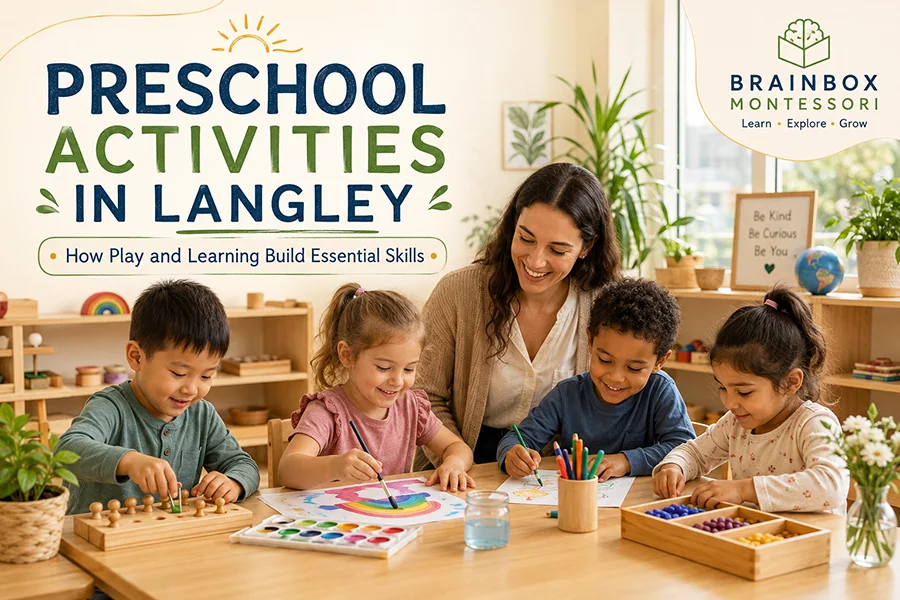
To adults, children’s activities sometimes look like simple play.
A child may be building with blocks, arranging objects, drawing, pouring water, listening to a story, or exploring materials outdoors.
But underneath these activities, significant learning is taking place.
Well-planned preschool activities in Langley can help children develop language, coordination, concentration, social skills, creativity, independence, and early academic concepts.
The most effective early childhood activities combine learning with exploration.
Practical Life Activities
Practical Life activities are especially important in Montessori education.
These exercises allow children to practice everyday skills they see at home and in the community.
Examples can include:
- Pouring water
- Transferring objects
- Folding
- Cleaning
- Food preparation
- Buttoning and fastening
- Organizing materials
These activities develop far more than practical abilities.
They also strengthen fine motor control, hand-eye coordination, patience, sequencing, and concentration.
Most importantly, they give children the satisfaction of being able to complete meaningful tasks independently.
Building Fine Motor Skills
Children eventually need precise hand movements for activities such as writing, drawing, cutting, dressing, and using classroom tools.
Before these skills develop, children need many opportunities to strengthen their fingers and hands.
Preschool activities that support fine motor development may include:
- Puzzles
- Threading
- Sorting
- Drawing
- Painting
- Building
- Manipulating small objects
- Using child-sized tools
These experiences help prepare children for later academic tasks without placing unnecessary pressure on them.
Language and Communication Activities
Children develop language through conversations and meaningful experiences.
Storytelling, reading, singing, naming objects, group discussions, and everyday conversations all contribute to vocabulary development.
Educators can support language development by introducing new words naturally and encouraging children to express ideas.
Books are also an important part of early literacy.
Before children learn to read independently, they can develop skills such as listening, understanding stories, recognizing sounds, and becoming familiar with printed language.
These foundations help prepare children for later reading development.
Early Mathematics(opens in new tab) Through Concrete Materials
Young children often understand mathematical ideas more easily when they can work with physical objects.
Instead of introducing mathematics only through written numbers, preschool activities can allow children to experience concepts directly.
Children may explore:
- Counting
- Sorting
- Matching
- Patterns
- Shapes
- Size
- Quantity
- Sequence
Montessori materials often make abstract ideas more concrete.
Children can physically manipulate objects and observe relationships before moving toward more symbolic concepts.
Creative Activities
Art gives children another way to communicate.
Painting, drawing, collage, modelling, and other creative experiences allow children to experiment with shapes, textures, movement, and ideas.
The purpose does not always need to be producing a perfect finished project.
The process itself is valuable.
Creative activities can encourage imagination, decision-making, fine motor development, and self-expression.
Outdoor Activities
Children need opportunities to move their bodies and experience the outdoors.
Outdoor play can support gross motor development through activities such as:
- Running
- Climbing
- Balancing
- Throwing
- Walking
- Exploring natural environments
Outdoor experiences also introduce children to weather, plants, insects, seasons, textures, and other aspects of the natural world.
This creates opportunities for both physical activity and scientific curiosity.
Social Learning Through Play
Preschool is an important environment for social development.
Children begin learning how to participate in a group while still developing their own independence.
During classroom activities they practice:
- Sharing space
- Taking turns
- Communicating needs
- Listening
- Cooperating
- Respecting boundaries
- Solving disagreements
These skills cannot be developed through worksheets alone.
They grow through real interactions with other children and adults.
Why Independent Activity Matters
Children benefit when they have opportunities to choose appropriate activities independently.
Making choices encourages decision-making and responsibility.
When children select an activity, complete it, and return the materials afterward, they participate in the entire learning process.
This experience can develop confidence and self-discipline.
It also encourages children to see themselves as capable learners rather than passive recipients of instruction.
Choosing Meaningful Preschool Activities in Langley
Parents comparing preschool programs should look beyond a simple list of activities.
The more important question is what children are learning through those activities.
Strong preschool activities in Langley should be developmentally appropriate, purposeful, engaging, and flexible enough to respond to individual interests.
At Brainbox Montessori, learning activities are designed to help children participate actively in their development while building practical, social, cognitive, and physical skills.
By giving children opportunities to explore and practice independently, early childhood education can establish strong foundations for future learning.
Frequently Asked Questions
What activities are good for preschool children?
Activities involving movement, language, practical skills, art, sensory exploration, puzzles, mathematics, and outdoor play can all support development.
Why is play important in preschool?
Play allows children to experiment, communicate, solve problems, practice physical skills, and understand social relationships.
How do Montessori activities support learning?
Montessori activities are generally hands-on and purposeful, allowing children to practice specific skills independently and repeat activities as needed.