
Infant Daycare in Langley: 7 Things Parents Should Know Before Enrolling
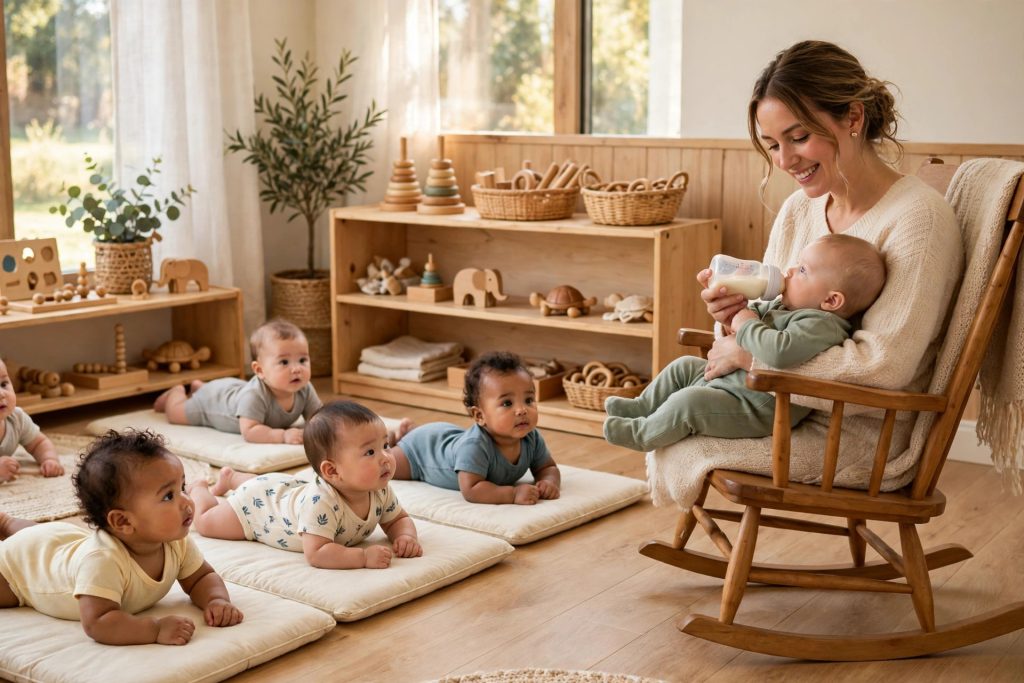
Finding infant daycare in Langley can feel harder than choosing any other kind of child care. Preschoolers can tell you about their day, and toddlers can at least point at what they liked. Infants cannot advocate for themselves at all, so the room, the routines, and the people caring for them matter even more. If you are returning to work after parental leave — or planning ahead while you are still pregnant — here is what to know before you enrol your baby in an infant daycare in Langley program.
Table of Contents
- What Infant Daycare in Langley Really Looks Like
- 7 Things to Know Before You Enrol Your Baby
- 1. How Many Babies Per Educator?
- 2. Safe Sleep Practices
- 3. Feeding: Bottles, Breast Milk, and Starting Solids
- 4. What a Montessori Infant Room Does Differently
- 5. Separation Anxiety and the Transition Plan
- 6. What to Watch on Your Tour of the Infant Room
- 7. Waitlists: When to Join
- How Montessori Infant Daycare in Langley Differs From a Typical Nursery
- Getting Your Baby Ready for the First Weeks
- What Infant Daycare in Langley Costs
- Frequently Asked Questions
- Book a Tour and See the Infant Room Yourself
What Infant Daycare in Langley Really Looks Like
An infant room is a calmer, quieter world than a preschool classroom. Babies under 18 months spend much of their day eating, sleeping, and being held — and in a good program, every one of those moments is treated as learning time. Caregivers narrate what they are doing, sing during diaper changes, and give babies long stretches of uninterrupted floor time to roll, reach, and pull up.
7 Things to Know Before You Enrol Your Baby
Use these seven points as your checklist when you compare an infant daycare in Langley option against the alternatives.
1. How Many Babies Per Educator?
Ratios are the single biggest quality indicator in infant care. In British Columbia, licensed group child care for children under 36 months allows a maximum of 12 children with a 1:4 educator-to-child ratio. Many programs choose to run smaller than the maximum, because four young infants per adult is already a full, demanding room.
When you visit an infant daycare in Langley program, ask for the actual ratio in the infant room — not the centre-wide average. Also ask how the room handles staff breaks and absences: a good program has a familiar substitute the babies already know, not a stranger pulled in at the last minute.
2. Safe Sleep Practices
Babies in full-time care may take both daily naps at the centre, so safe sleep is non-negotiable. Ask how the room handles it: infants placed on their backs to sleep, bare sleep surfaces without blankets, pillows, or bumpers, and regular visual checks while babies sleep. The sleep area should be quiet, dim, and separate from the play space so that one baby waking does not wake the rest.
Also ask how the program handles your baby’s own sleep cues. Young infants do not all nap at the same time, and a quality infant daycare in Langley room follows individual sleep rhythms rather than forcing every baby onto one schedule. That flexibility is one of the clearest signs of a baby-centred program.
3. Feeding: Bottles, Breast Milk, and Starting Solids
Feeding is where infant care gets personal. If you are breastfeeding, ask whether the centre accepts expressed milk, how it is labelled and stored, and whether you are welcome to come and nurse during the day. Many working parents of young babies choose an infant daycare in Langley program close to home or work precisely so a midday nursing visit is possible.
For formula-fed babies, ask how bottles are prepared and how the centre tracks what each baby drank. When your baby starts solids — usually around six months — find out how new foods are introduced, how allergies are managed, and whether you will get a daily report of what your baby ate.
4. What a Montessori Infant Room Does Differently
A Montessori infant daycare in Langley classroom — traditionally called the “nido,” or nest — looks noticeably different from a conventional nursery. Instead of swings, bouncers, and containers, you will see open floor space for free movement, low floor beds rather than rows of cribs in the play area, and simple, natural materials at the baby’s level: grasping toys, low mirrors, and a weaning table and chair sized for a baby who is learning to eat independently.
The philosophy behind it is straightforward: even very young babies are capable learners, and they develop best when they can move freely and choose what to engage with. Caregivers in a Montessori infant daycare in Langley room spend more time observing than directing — watching for the moment a baby is ready to roll, sit, or grasp, and then preparing the environment to support it.
5. Separation Anxiety and the Transition Plan
A thoughtful program does not pretend the first weeks will be tear-free; it plans for them. Ask what the transition looks like: the best infant rooms offer a gradual start, with short visits alongside a parent, then half days, building up to full days over one to two weeks.
Ask who will be your baby’s primary caregiver, because that one consistent relationship is what carries a baby through the wobbly first weeks. And ask how the centre communicates during the day — a quick photo or message at naptime can turn a hard morning at your desk into a manageable one. If you are still weighing the Montessori approach itself, read why families choose Montessori daycare in Langley.
6. What to Watch on Your Tour of the Infant Room
When you tour an infant daycare in Langley program, try to visit during the morning, when the room is in full swing. Watch the caregivers’ hands and voices: are babies picked up gently and spoken to warmly, or handled quickly and in silence? Notice the noise level — a good infant room hums rather than blares — and check that the space smells clean without heavy fragrance.
Look at the babies themselves. Do they look content and engaged, or are several crying unattended? A brief fuss is normal; a room where crying goes unanswered is not. For a broader checklist that applies to every age group, see what to look for in a licensed childcare centre.
7. Waitlists: When to Join
Infant spaces are the scarcest in child care. Because ratios are low and babies stay in the infant room for many months, turnover is slow — most centres have far fewer infant spots than preschool spots. In practice, that means joining a waitlist months before you need care, and many Langley parents join while still pregnant or on early parental leave.
Ask how the waitlist works: is it first-come, first-served, or priority-based (siblings, for example)? Is there a fee to join, and is it refundable? And crucially, ask for a realistic timeline rather than a vague promise. For background on the province’s child care landscape, see BC’s ChildCareBC programs and licensing information. If you are comparing options across the area, our guide to child care for working parents in Langley can help you weigh location, hours, and program fit.
How Montessori Infant Daycare in Langley Differs From a Typical Nursery
It helps to name the differences plainly, because “Montessori” is sometimes used loosely. In an authentic Montessori infant daycare in Langley environment, you will notice four things a conventional nursery often lacks — and you can read the full philosophy in the school’s Montessori curriculum. First, freedom of movement: babies spend their awake time on the floor, not in containers, so they build strength and coordination naturally. Second, a prepared environment scaled to the baby: low shelves, floor beds, and child-sized weaning furniture instead of equipment that keeps babies still. Third, observation-led caregiving: educators trained to watch for developmental windows and respond, rather than running the room on a fixed activity schedule. Fourth, respect for the baby’s pace: feeding and sleeping follow the child, not the clock.
None of this means a Montessori infant room is unstructured. The structure is simply built around developmental needs rather than adult convenience.
Getting Your Baby Ready for the First Weeks
A little preparation smooths the start for everyone. If your baby has never taken a bottle from anyone but you, practise with your partner or a grandparent a few weeks ahead. Shift nap times gradually toward the centre’s rhythm, and let your baby spend short stretches with other trusted adults so a new caregiver is not the first unfamiliar face.
Pack with the room in mind: labelled bottles, enough diapers and wipes, two full changes of clothes, a comfort object if your baby has one, and any expressed milk clearly dated. Ask the centre for its own list — every infant daycare in Langley program has one — and label everything.
What Infant Daycare in Langley Costs
Infant care is typically the most expensive age group in child care, because low ratios mean higher staffing costs per child. Fees vary widely between centres depending on hours, program type, and what is included, so always compare full-day rates and ask what is covered — meals, diapers, and wipes are included at some centres and billed separately at others.
Two things are worth knowing about the bigger picture. First, infant spaces cost centres more to operate, which is one reason waitlists for under-18-month spots are the longest. Second, British Columbia continues to invest in child care affordability through its ChildCareBC initiatives, so it is worth checking current provincial programs when you budget.
Frequently Asked Questions
At what age can my baby start infant daycare in Langley?
Most licensed infant programs accept babies from around 3 to 6 months, once parental leave ends, and care for them until about 18 months, when they transition to the toddler room. Centres set their own minimum age, so confirm it when you enquire — and join the waitlist early, because infant spots fill fastest.
How do I know my baby is ready for daycare?
There is no single readiness milestone for babies the way there is for preschoolers. The practical signs are simpler: your baby can take a bottle or cup from someone other than you, naps reasonably away from home, and is comfortable being soothed by another trusted adult. A gradual transition plan covers the rest.
What should I pack for my baby each day?
Expect a daily list along these lines: labelled bottles or sippy cups, expressed milk or formula, diapers and wipes, two changes of clothes, a sleep sack if the centre uses them, and a small comfort item. Label everything — infant rooms run on labelling.
How long does the adjustment period take?
Most babies settle within two to four weeks, though some take longer — and a brief regression around a developmental leap or illness is normal. Consistent drop-off routines (same caregiver, same goodbye ritual, a confident exit) shorten the adjustment far more than lingering at the door.
Can I visit or breastfeed during the day?
Many infant programs welcome midday visits, and some parents plan their centre choice around it. Ask about the policy before you enrol: open-door visiting, a comfortable nursing space, and clear sign-in procedures are all good signs of a baby-centred program.
Book a Tour and See the Infant Room Yourself
Choosing infant daycare in Langley is ultimately a decision you make with your eyes and your instincts, not just a checklist. Visit in the morning, watch how caregivers hold and speak to the babies, and notice whether the room feels calm. The right infant room will feel like an extension of home — safe, warm, and attentive to your baby as an individual.
If you would like to see a Montessori infant room in action, book a tour and come meet the educators who would care for your baby. Check our programs and hours for schedule options first — we would love to show you around.