
Montessori Preschool Surrey: 7 Things to Look for When Your 3-Year-Old Is Ready
Your three-year-old has started sorting the cutlery by size, pouring their own water (mostly without spilling), and asking “why” about everything — and you are starting to wonder whether a Montessori preschool Surrey families trust might be the right next step. The preschool years, roughly ages three to five, are when children move from parallel play into real friendships and from needing help with everything to proudly doing things “all by myself.”
Choosing a Montessori preschool Surrey offers is not just about finding a classroom with an open spot. It is about finding a room where your child will be known, a rhythm that suits a three-year-old, and educators who understand this age. Here are seven things to check before you enrol.
Table of Contents
- What a Montessori Preschool in Surrey Really Looks Like
- 7 Things to Check Before You Enrol Your Preschooler
- 1. Is Your Child Ready? Signs to Watch For
- 2. What Makes a Montessori Preschool Different
- 3. The Montessori Preschool Day: Work, Play, and Outdoor Time
- 4. How the Program Builds Independence and Concentration
- 5. Language, Math, and Early Literacy the Montessori Way
- 6. Social Skills and Grace and Courtesy
- 7. What to Ask on Your Tour
- Montessori Preschool vs. Conventional Preschool in Surrey
- Getting Your Child Ready for the First Weeks
- When to Join a Waitlist for a Montessori Preschool
- What a Montessori Preschool Costs
- Frequently Asked Questions
- Book a Tour and See the Preschool Classroom Yourself
What a Montessori Preschool in Surrey Really Looks Like
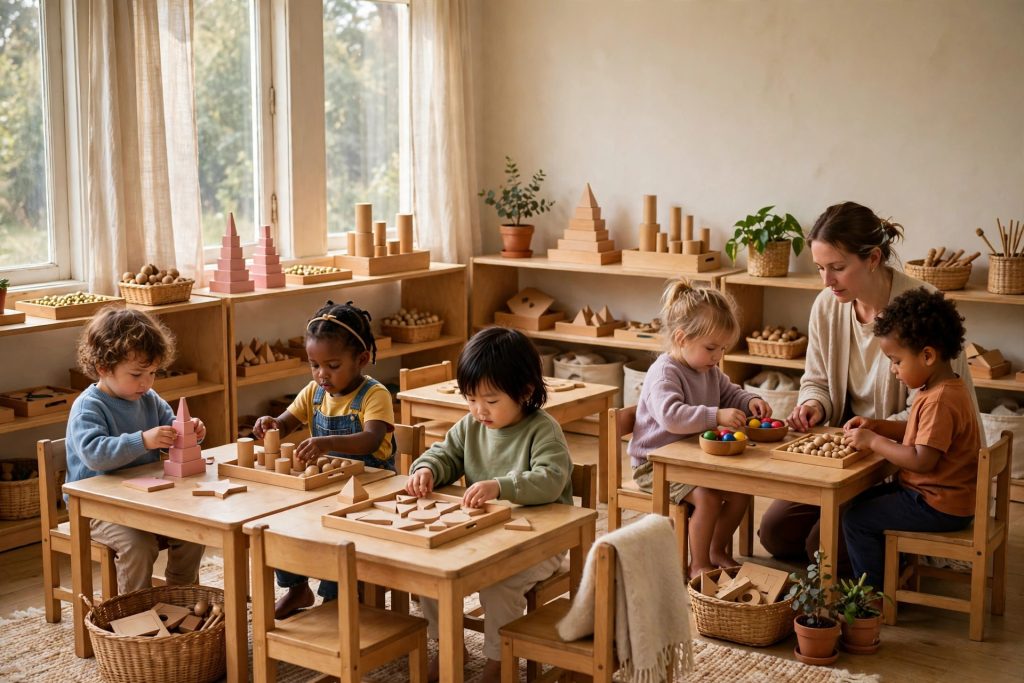
A Montessori preschool classroom feels calm the moment you walk in — and that calm is deliberate. Children aged three to five share one room, and each child chooses their own work from low, open shelves: pouring water between glass jugs, polishing a small mirror, tracing sandpaper letters, or building the pink tower. There is no single activity that the whole class must do at the same time.
The room is divided into areas rather than rows of desks: practical life, sensorial work, language, mathematics, and culture. You will see child-sized tables and chairs and real glass and ceramic materials instead of plastic. A good Montessori preschool Surrey parents visit should feel more like a thoughtfully arranged home than a school hall.
7 Things to Check Before You Enrol Your Preschooler
Use these seven points as your checklist when you compare a Montessori preschool Surrey has available.
1. Is Your Child Ready? Signs to Watch For
There is no single birthday on which a child becomes ready for preschool. Most children start somewhere between three and four, and readiness shows up in behaviour rather than age. Look for a child who can separate from you for a morning with another trusted adult, who is interested in other children, and who can follow a two-step direction.
Other encouraging signs: your child can sit for a short story, shows curiosity about letters and numbers, and wants to do everyday tasks independently — dressing, pouring, tidying up. A good Montessori preschool Surrey families choose expects three-year-olds to be works in progress, and the educators’ job is to meet your child where they are.
2. What Makes a Montessori Preschool Different
The difference starts with the prepared environment. Shelves are low and open, so a three-year-old can choose a material, carry it to a small table or floor mat, work with it for as long as they wish, and put it back when finished. Every material teaches one skill at a time and lets the child spot their own mistake — no adult correction needed.
The mixed-age group is the second difference. Three-, four-, and five-year-olds share one classroom, so younger children learn by watching older ones, and older children deepen their own understanding by helping. The third difference is the teacher’s role: Montessori educators observe far more than they direct, watching for the moment a child is ready for a new challenge, then quietly presenting it. That respect for concentration is what builds independence. You can read the full approach in the school’s Montessori curriculum.
3. The Montessori Preschool Day: Work, Play, and Outdoor Time
A Montessori day is built around a long, uninterrupted work period — often two to three hours in the morning — during which children choose their activities freely. Ask to see a sample day: how long is the work period, when do children go outside, and how are group times, meals, and rest handled?
Outdoor time deserves a specific question. Children aged three to five need daily outdoor play for gross-motor development, and the best programs treat the outdoors as a second classroom — climbing, digging, riding, and exploring nature — rather than a brief break between indoor activities. Also ask about meals: are they provided, how are allergies handled, and will you get a report of what your child ate?
4. How the Program Builds Independence and Concentration
Independence is not a slogan at a Montessori preschool Surrey parents choose; it is the daily practice. Children serve their own snacks, pour their own drinks, button their own coats, and clean up their own spills. These small acts of competence build a child who believes “I can do it myself” — and that belief carries into every new challenge.
Concentration grows from the same practice. When a child is deeply engaged in pouring or building, the educator does not interrupt to move on to the next scheduled activity. Over months, those protected stretches of focus lengthen — parents notice the change at home. If you are weighing preschool against staying home a little longer, our guide to child care for working parents in Langley can help you think through location, hours, and program fit.
5. Language, Math, and Early Literacy the Montessori Way
Between three and five, language and early maths develop fast, and Montessori materials are designed to make that growth hands-on. Children trace sandpaper letters while saying the sound, build words with a movable alphabet long before they can hold a pencil neatly, and count with golden beads they can hold in their hands. Reading and writing emerge from these physical experiences rather than from worksheets.
Ask how the program handles different stages: a three-year-old learning letter sounds and a five-year-old reading simple books should both find work that challenges them. That is exactly what the mixed-age classroom makes possible — and it is one of the clearest signs of an authentic program. For background on why these years matter so much, see the Association Montessori Internationale on the preschool years.
6. Social Skills and Grace and Courtesy
At a Montessori preschool Surrey parents recommend, three-year-olds are learning to be part of a group for the first time, and the classroom teaches that skill explicitly. “Grace and courtesy” lessons cover the small things adults often forget to teach: how to greet someone, how to ask for a turn, how to watch another child’s work without touching it, and how to say sorry and mean it.
A good program does not punish a child for grabbing a toy; it teaches turn-taking patiently and gives children the language to ask. When you tour, watch how the educators speak to the children: do they get down to the child’s eye level, use warm and respectful language, and give children time to answer? For a broader sense of quality at any age, read what to look for in a licensed childcare centre.
7. What to Ask on Your Tour
A tour is your best chance to see a program honestly, so visit during the morning work period, when the room is in full swing. Notice whether the children look busy and content, and whether the educators seem calm or stretched thin.
Bring specific questions: What does a typical day look like? How do you handle hitting or other big behaviours? How do you communicate with parents — daily reports, photos, an app? What is your sick-child policy? And ask about staff: how long have the preschool educators been at the centre, and what training do they hold? Stability matters enormously to young children, who bond with their caregivers. For a general checklist, see why families choose Montessori daycare in Langley.
Montessori Preschool vs. Conventional Preschool in Surrey
It helps to name the differences plainly, because “Montessori” is sometimes used loosely. In an authentic Montessori preschool Surrey families choose, you will notice four things a conventional preschool often lacks. First, independence: children choose their own activities, serve their own snacks, and clean up after themselves, building real competence at three years old. Second, a prepared environment scaled to the child: low shelves, child-sized furniture, and real materials instead of equipment that keeps children contained. Third, observation-led teaching: educators trained to watch for sensitive periods — language, order, movement — and respond with the right material at the right moment. Fourth, respect for concentration: when a child is deeply engaged, the adult does not interrupt.
None of this means a Montessori preschool is unstructured — the structure is built around developmental needs rather than adult convenience. That is the core of what a Montessori preschool Surrey offers that is hardest to find elsewhere.
Getting Your Child Ready for the First Weeks
A little preparation smooths the start for everyone. In the weeks before your child begins, practise short separations with a grandparent or trusted friend, and talk about the new school with excitement.
Keep the first mornings calm and predictable: the same goodbye ritual, a confident exit, and no lingering at the door — preschoolers take their emotional cues from you. Most children settle within two to four weeks, though some take longer, and a consistent routine shortens the adjustment far more than any pep talk.
When to Join a Waitlist for a Montessori Preschool
Preschool spaces at a Montessori preschool Surrey parents recommend are scarce, because children stay in the room for two years or more and turnover is slow. In practice, that means joining well before you need care — many Surrey and Langley parents join while their child is still in the toddler room.
Ask how the waitlist works: is it first-come, first-served, or priority-based (siblings, for example)? Is there a fee to join, and is it refundable? And ask for a realistic timeline rather than a vague promise.
What a Montessori Preschool Costs
Montessori preschool fees vary widely between centres depending on hours, program type, and what is included, so always compare full-day rates and ask what is covered — meals, snacks, and field trips are included at some centres and billed separately at others.
British Columbia also continues to invest in child care affordability through its ChildCareBC initiatives, so it is worth checking current provincial programs when you budget for a Montessori preschool Surrey families are comparing.
Frequently Asked Questions
What age does a Montessori preschool in Surrey accept?
Most Montessori preschools accept children from around three years old until kindergarten entry at about age five, depending on the centre. Confirm the minimum age when you enquire, and join the waitlist early.
How do I know if my three-year-old is ready for a Montessori preschool?
Look for everyday signs rather than a single milestone: your child separates from you for a morning with another trusted adult, shows interest in other children, follows a two-step direction, and is curious about doing things independently. A gradual transition plan covers the rest.
Does my child need to be toilet trained before starting preschool?
Most Montessori preschools expect children to be working toward independence with toileting, but expectations vary. Ask how the program supports children who are still learning, whether child-sized toilets are available, and how educators handle accidents — calmly and without shame is the answer you want.
What should my preschooler bring each day?
Expect a daily list along these lines: a labelled water bottle, a full change of clothes, indoor shoes, sunscreen and a hat for outdoor play, and a small comfort item if your child has one. Label everything.
How is a Montessori preschool different from a regular preschool?
The main differences at a Montessori preschool Surrey families choose are the prepared environment with self-correcting materials, the mixed-age classroom, child-chosen work during a long uninterrupted period, and educators who observe and guide rather than direct the whole group. The result is a child who learns independence and concentration alongside language and early maths.
Book a Tour and See the Preschool Classroom Yourself
Choosing a Montessori preschool Surrey offers is ultimately a decision you make with your eyes and your instincts, not just a checklist. Visit in the morning and watch how educators speak to the children. The right preschool classroom will feel like a place where your three-year-old is known and respected.
If you would like to see a Montessori classroom in action, book a tour and come meet the educators who would care for your child. Check our programs and hours for schedule options first — we would love to show you around.