
Montessori Daycare Surrey: 7 Things to Know Before You Enrol
Your commute takes you through Surrey every morning, your toddler has suddenly started pouring their own juice, and the daycare search you kept putting off has become urgent — a Montessori daycare Surrey families trust might be the answer you have been looking for. Full-day Montessori care combines the independence-building approach of a Montessori classroom with the hours working parents actually need.
Choosing a Montessori daycare Surrey offers is about more than finding an open spot near your route to work. It is about finding a place where your child spends the whole day in a prepared environment, with educators who know them, and a rhythm that supports independence from drop-off to pick-up. Here are seven things to check before you enrol.
What a Montessori Daycare in Surrey Really Looks Like
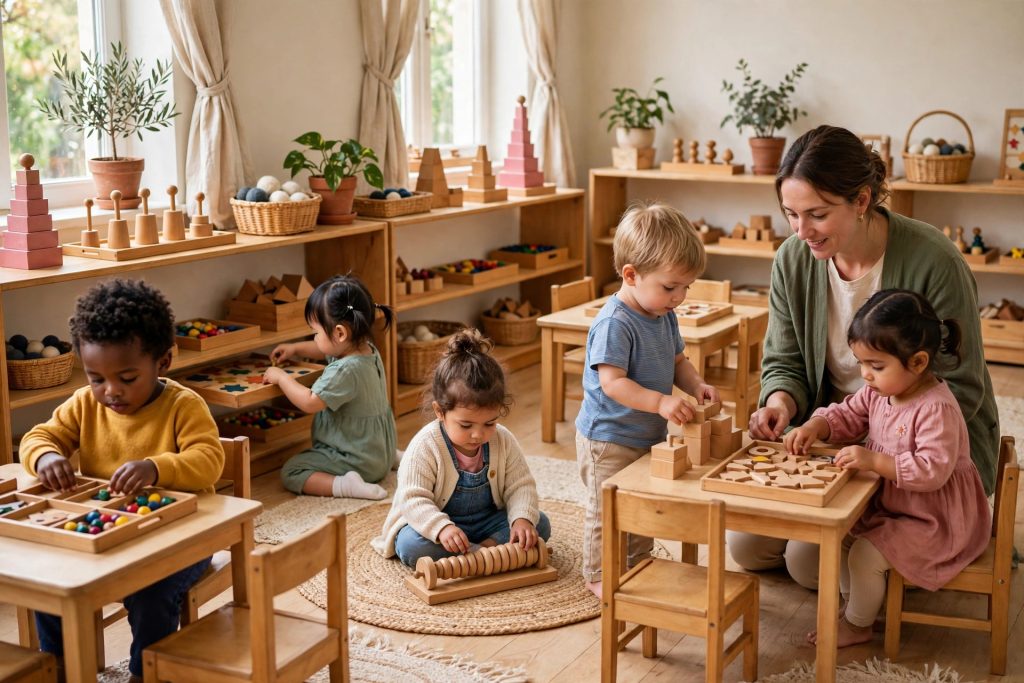
A Montessori daycare classroom feels calm the moment you walk in — and that calm is deliberate. Toddlers and preschoolers share a room, and each child chooses their own work from low, open shelves: pouring water between small jugs, polishing a mirror, tracing sandpaper letters, or building the pink tower. There is no single activity the whole group must do at the same time.
The room is divided into areas rather than rows of desks: practical life, sensorial work, language, mathematics, and culture. You will see child-sized tables and chairs and real glass and ceramic materials instead of plastic. A good Montessori daycare Surrey parents visit should feel more like a thoughtfully arranged home than a school hall — and it should feel that way at 8 a.m. and at 4 p.m., because full-day care means the room is your child’s whole day, not just a morning program.
7 Things to Check Before You Enrol
Use these seven points as your checklist when you compare a Montessori daycare Surrey has available.
1. Full-Day Care That Still Feels Montessori
The first question is simple: does the Montessori approach survive the afternoon? At a Montessori daycare Surrey families choose for full-day care, the morning work period is followed by lunch, rest, and a second, quieter stretch of work and outdoor play — not by hours of videos or unstructured waiting for pick-up. Ask to see a sample full-day schedule.
Also ask how the day changes for the youngest children. Toddlers nap earlier and need a calm rest space, while four- and five-year-olds may rest briefly and then return to activities. A program that treats the afternoon as real learning time, not babysitting time, is worth its fees. Check our programs and hours to see how a full day is structured.
2. Mixed-Age Classrooms, Not Age-Segregated Rooms
The mixed-age group is one of the clearest signs of an authentic program. In a Montessori daycare Surrey classroom, children from around eighteen months to five years often share one room, so younger children learn by watching older ones, and older children deepen their own understanding by helping. That is very different from a centre that groups children strictly by birth year.
Ask how the age range works in practice: how many children are in the room, how are the youngest kept safe while older children use more advanced materials, and how do educators make sure a two-year-old and a four-year-old both find work that challenges them? The answers tell you whether “mixed age” is a real practice or just a line on the website.
3. The Prepared Environment: Low Shelves and Real Materials
The prepared environment is the heart of Montessori, and it is easy to check with your own eyes. Shelves should be low and open, so a two-year-old can choose a material, carry it to a small table or floor mat, work with it for as long as they wish, and put it back when finished. Every material should teach one skill at a time and let the child spot their own mistake.
Look for real materials — glass, ceramic, wood, metal — instead of plastic toys, and for child-sized furniture your toddler can actually move. If the room looks like a conventional daycare with a few Montessori posters on the wall, the approach probably stops at the label. You can read the full approach in the school’s Montessori curriculum.
4. Educator Training and Staff Stability
Montessori is a method, not a vibe, and it only works when the adults in the room are trained in it. Ask what training the educators hold: a Montessori diploma or certificate from a recognized training centre is the standard to look for, and it matters far more than a general early-childhood credential alone.
Stability matters just as much. Young children bond with their caregivers, and a revolving door of educators undermines everything the classroom is trying to build. Ask how long the current educators have been at the centre and what the turnover looks like. If you are weighing daycare against staying home a little longer, our guide to child care for working parents in Langley can help you think through location, hours, and program fit.
5. Daily Outdoor Time, Not an Afterthought
Children under five need daily outdoor play for gross-motor development, and the best programs treat the outdoors as a second classroom — climbing, digging, riding, and exploring nature — rather than a brief break between indoor activities. When you tour a Montessori daycare Surrey parents recommend, ask how long children spend outside each day and in what weather.
Also ask what the outdoor space actually offers. A fenced yard with a climbing structure is a start; a yard with sand, water, a garden bed, and room to run is much better. And ask about the wet-weather plan: in the Lower Mainland, a program that only goes out on sunny days is a program that barely goes out at all.
6. How the Daycare Communicates With Parents
Full-day care means you hand your child over for eight or more hours, so communication is not a nice extra — it is the whole relationship. Ask how the daycare keeps you informed: daily reports, photos, an app, or a quick chat at pick-up? Will you hear what your child ate, how long they napped, and what they worked on?
Also ask how concerns are raised. If your child is struggling with separation or a behaviour, will someone call you the same day, or will you find out weeks later at a parent meeting? A good program treats parents as partners and has a clear, named person you can contact. For a broader sense of quality at any age, read what to look for in a licensed childcare centre.
7. Licensing, Ratios, and Safety Basics
Every legitimate daycare in British Columbia must be licensed, and licensing is your floor, not your ceiling. Confirm the centre holds a current licence and ask about its ratios: how many children is each educator responsible for, and does the centre run below the legal maximum? Smaller groups mean more attention for your child.
Then look at the basics with fresh eyes. Are the exits clear, the gates latched, and the first-aid kit visible? Is there a written sick-child policy, and how are allergies handled at meals? These details are boring until the day they matter — and a centre that handles them calmly and openly is a centre you can trust. For a general checklist, see why families choose Montessori daycare in Langley.
Montessori Daycare vs. Conventional Daycare in Surrey
It helps to name the differences plainly, because “Montessori” is sometimes used loosely. In an authentic Montessori daycare Surrey families choose, you will notice four things a conventional daycare often lacks. First, independence: children choose their own activities, serve their own snacks, and clean up after themselves, building real competence at two and three years old. Second, a prepared environment scaled to the child: low shelves, child-sized furniture, and real materials instead of equipment that keeps children contained. Third, observation-led teaching: educators trained to watch for sensitive periods — language, order, movement — and respond with the right material at the right moment. Fourth, respect for concentration: when a child is deeply engaged, the adult does not interrupt.
None of this means a Montessori daycare is unstructured — the structure is built around developmental needs rather than adult convenience. That is the core of what a Montessori daycare Surrey offers that is hardest to find elsewhere.
When to Join a Waitlist
Daycare spaces at a Montessori daycare Surrey parents recommend are scarce, because children stay for years and turnover is slow. In practice, that means joining well before you need care — many Surrey and Langley parents join while their child is still under one, or as soon as they return to work planning begins.
Ask how the waitlist works: is it first-come, first-served, or priority-based (siblings, for example)? Is there a fee to join, and is it refundable? And ask for a realistic timeline rather than a vague promise — a centre that gives you an honest “six to twelve months” is more trustworthy than one that says “soon.”
What a Montessori Daycare Costs
Montessori daycare fees vary widely between centres depending on hours, program type, and what is included, so always compare full-day rates and ask what is covered — meals, snacks, and field trips are included at some centres and billed separately at others. Do not compare a full-day Montessori rate with a half-day preschool rate; they are different services.
British Columbia continues to invest in child care affordability through its ChildCareBC initiatives, so it is worth checking current provincial programs when you budget for a Montessori daycare Surrey families are comparing. See the ChildCareBC programs and fee-reduction information for the latest details.
Frequently Asked Questions
What ages does a Montessori daycare in Surrey accept?
Most Montessori daycares accept children from around eighteen months until kindergarten entry at about age five, depending on the centre. Confirm the minimum age when you enquire, and join the waitlist early — toddler and infant spots fill fastest.
How do I know if my toddler is ready for a Montessori daycare?
Look for everyday signs rather than a single milestone: your child separates from you for a morning with another trusted adult, shows interest in other children, follows a simple direction, and is curious about doing things independently. A gradual transition plan covers the rest.
Does my child need to be toilet trained before starting daycare?
Most Montessori daycares expect children to be working toward independence with toileting, but expectations vary by age group. Ask how the program supports children who are still learning, whether child-sized toilets are available, and how educators handle accidents — calmly and without shame is the answer you want.
What should my child bring each day?
Expect a daily list along these lines: a labelled water bottle, a full change of clothes, indoor shoes, sunscreen and a hat for outdoor play, and a small comfort item if your child has one. Label everything — in a room full of toddlers, unlabelled items disappear fast.
How is a Montessori daycare different from a regular daycare?
The main differences at a Montessori daycare Surrey families choose are the prepared environment with self-correcting materials, the mixed-age classroom, child-chosen work during a long uninterrupted period, and educators who observe and guide rather than direct the whole group. The result is a child who learns independence and concentration alongside language and early maths.
Book a Tour and See the Classroom Yourself
Choosing a Montessori daycare Surrey offers is ultimately a decision you make with your eyes and your instincts, not just a checklist. Visit in the morning and watch how educators speak to the children. The right daycare classroom will feel like a place where your toddler is known and respected.
If you would like to see a Montessori classroom in action, book a tour and come meet the educators who would care for your child. Check our programs and hours for schedule options first — we would love to show you around.